Managers and decision-makers
Briefings and workshops on opportunities, risks, governance and investment priorities. Analysis, summaries and critical evaluation of outputs to support decisions.

AI Training
AI skills for everyday work. We design programs to help people choose, use and evaluate artificial intelligence, combining exercises based on participants’ tasks, shared guidelines and adoption support.
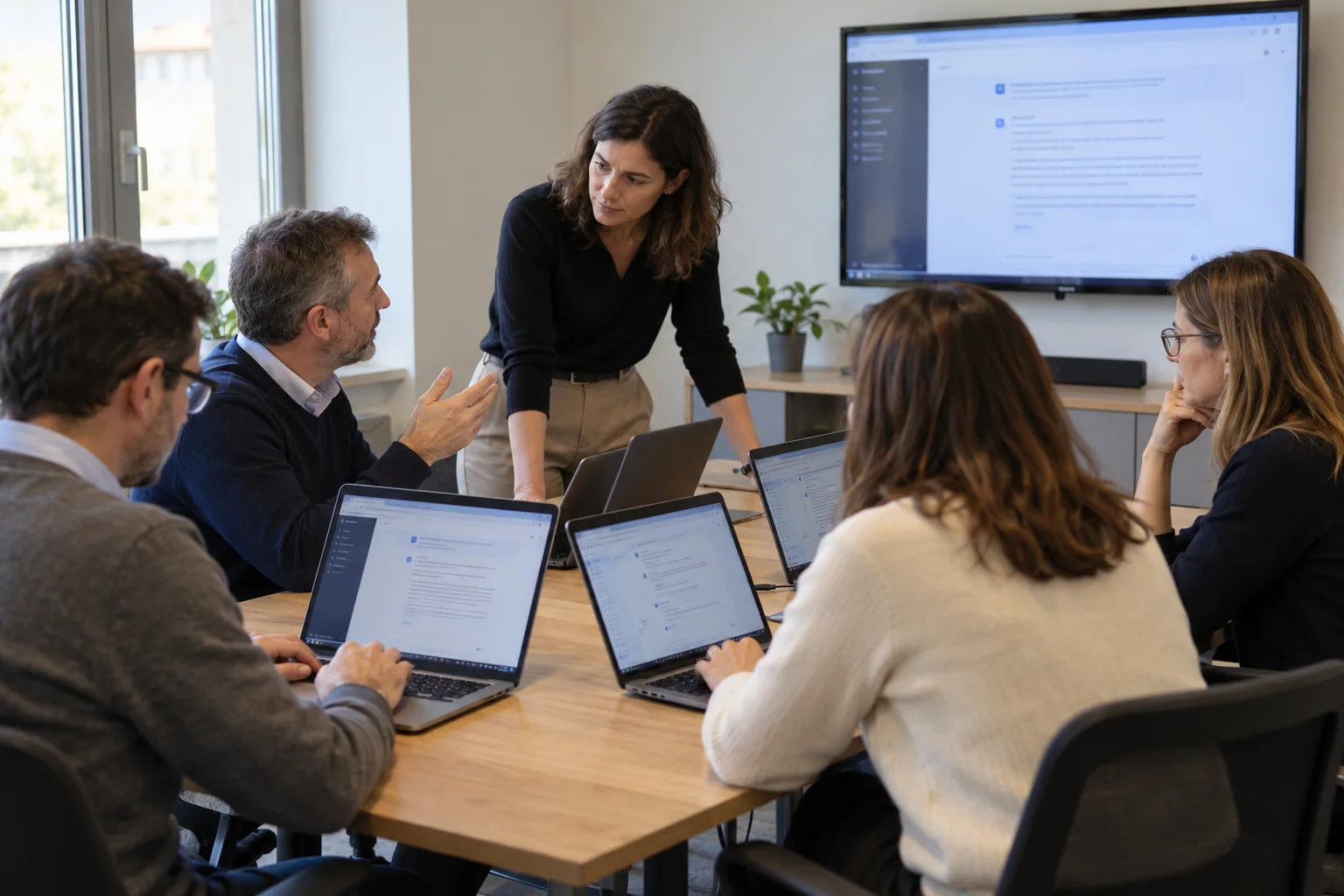
People and objectives
Objectives, existing skills and working context guide the design. From sessions for decision-makers to hands-on workshops and company-wide programs spanning several levels.
Briefings and workshops on opportunities, risks, governance and investment priorities. Analysis, summaries and critical evaluation of outputs to support decisions.
Exercises using documents, emails, reports, research and recurring tasks. Methods, prompts and output checks applied to everyday work.
Role-based programs, internal communication, guidelines and change support. Build shared skills and sustain learning beyond the training sessions.
Learning by doing
We use examples and, where possible, documents and processes relevant to participants’ work. Each exercise connects the use of tools with the quality of the result and the checks it requires.
Prepare a summary, a draft message or a report: clarify the objective, audience and information to provide to the tool.
Compare a summary with its source document, identify missing or unsupported information and correct the output.
Distinguish which data can be used, choose tools consistent with company rules and define who reviews the result.

Tailored programs
Focused workshops or company-wide programs spanning several levels: we combine modules to suit the participants and objectives. Duration, tools and exercises are agreed during the design phase.
A shared vocabulary to understand the capabilities and limitations of tools and make informed choices about their use.
Documents, reports, communications, analysis and recurring tasks: practical examples connected to business processes.
Methods for writing, summarising, researching and comparing information, with a focus on verifying results.
Operating rules for tools, data, privacy, security, roles, responsibilities and permitted use cases.
Internal communication, role-based programs and adoption plans aligned with company culture and objectives.
Review tasks, documents and friction points to identify where to train people, automate work or develop applications.
Feedback, reusable materials and pilot use cases to help people take the next steps.
Our method
We work with company representatives to connect learning, day-to-day tasks and applications.

We identify roles, objectives, existing skills, tools in use and the processes involved.
We define modules, use cases, exercises, duration and practical objectives for the participants.
We work on prompts, outputs, checks and applications to real tasks.
We prepare practical guidance, rules of use and materials teams can reuse.
We gather feedback, identify pilot use cases and define the next steps.

Continuity after training
Follow-up support helps turn learning into working practices: we discuss experiences, review use cases and set priorities. We consider team autonomy, output quality, time and errors in relation to the tasks involved.
When an application need emerges, we connect training with the design of AI assistants, automations and integrations. The program can then lead to a practical project.
How we adapt training to your company’s needs.
No. The objective is practical: to help people use AI in real work, with a method, output checks and awareness of its limitations.
Yes. Managers, HR, operational teams, staff and business functions have different needs. Programs can be modular and span several levels.
Yes. Data, confidentiality, security, human oversight, hallucinations and accountability are integral parts of the program.
Yes, where possible. We start with documents, tasks and processes relevant to participants’ work.
Yes. We can support adoption, gather feedback, define guidelines, prioritise use cases and help with subsequent AI projects.
It depends on the roles and processes. We consider time, output quality, team autonomy, errors and use cases that could become automations or applications.
Your training program
In a 45-minute session, we review the participants, objectives and business processes together to identify a suitable path: training, workshops, governance or adoption support.
Tell us who you want to train and which tasks you would like to improve.